
Wednesday, August 3, 2022
Why Email is the Worst Way to Communicate!I
You've heard the saying many times: "free is not free". There's a cost to everything. Well, the same can be said for email. Email is free and there's horrible cost related to the free email: inundation. We are inundated by emails. They get lost in the shuffle. You know the conversation: "did you get that email I sent you?" "What email? I get 100 emails a day. How do you expect me to pick your out from the bunch?" And some folks get many more than 100--probably hundreds.

Saturday, July 23, 2022
Urgency: Without Sales, Everything Stops

Customers don't want to wait. When they need one of your products or services, they typically need it right away. The salesperson's job is to understand that urgency. The longer the customer waits for you to get back to them, or provide them with the information they need, the more likely that the order will be lost to the salesperson who recognizes the urgency.
Understanding a customer means understanding the customer's needs. The need may be a quotation so that the product can be budgeted. The need may be a drawing or specification so that the engineer can spec your product into the project.
Everyone reports to someone up the chain of command. It's important for the sales rep to understand that when someone asks you for something, it's because someone up the ladder wants the information--urgently. Without the quote, without the specifications, without the lead time information, the order gets lost to someone who recognizes the urgency.
In this time of supply chain delays, it's up to the sales rep to stay in touch with the customer--to keep the customer informed about the timing for whatever their current needs are.
The corollary to Urgency is Communication. Remember, again, everyone answers to someone up the corporate ladder. The more you communicate with your customer, the better the your contact looks to the bosses.
The underlying principle that will allow you to stay in communication with your customer, is to make follow-up lists. I have written a couple of blogs about making lists. The links are here.
Also, I highly recommend sales guru Brian G. Burns' YouTube channel "The Brutal Truth". The link to his videos is here. Brian can also be found on LinkedIn.
Remember, if you don't understand the urgency of the sales environment, someone else will. Losing an order or a customer to someone who recognizes the customer's needs is an unnecessary way to lose--a customer or an order.
Understanding a customer means understanding the customer's needs. The need may be a quotation so that the product can be budgeted. The need may be a drawing or specification so that the engineer can spec your product into the project.
Everyone reports to someone up the chain of command. It's important for the sales rep to understand that when someone asks you for something, it's because someone up the ladder wants the information--urgently. Without the quote, without the specifications, without the lead time information, the order gets lost to someone who recognizes the urgency.
In this time of supply chain delays, it's up to the sales rep to stay in touch with the customer--to keep the customer informed about the timing for whatever their current needs are.
The corollary to Urgency is Communication. Remember, again, everyone answers to someone up the corporate ladder. The more you communicate with your customer, the better the your contact looks to the bosses.
The underlying principle that will allow you to stay in communication with your customer, is to make follow-up lists. I have written a couple of blogs about making lists. The links are here.
Also, I highly recommend sales guru Brian G. Burns' YouTube channel "The Brutal Truth". The link to his videos is here. Brian can also be found on LinkedIn.
Remember, if you don't understand the urgency of the sales environment, someone else will. Losing an order or a customer to someone who recognizes the customer's needs is an unnecessary way to lose--a customer or an order.
Monday, June 13, 2022
Do Not Be A Lazy Salesperson

The digital age and COVID have created the so-called "lazy salesperson". The serious salesperson prospects a customer by learning the structure of the customer's company, what their function is in the supply chain, who the major players are in the company, and how they make decisions on what product they purchase. The lazy salesperson uses LinkedIn or some sort of blanket email to try to get the customer's attention--sort of like throwing a fishing line in the pond without any hook or bait. And the recipients of this lazy approach have their "Deleted" and "Junk" folders full of these non-specific emails.
What separates the lazy salesperson from the successful salesperson is their "pre-sale" research. Often the best way to find out how a company is organized, and who the players are, is through their website. Once you find out what the management structure is--then you go to LinkedIn to find if there is something more to be learned.
Once you have done all your research into the company you're going to approach, you must determine what your pitch is going to be. (Check out my blog on creating the Value Proposition.) One pitch does NOT fit all potential customers. The pitch has to be tailored to the specific needs of the customer you're approaching.
So, the first step in getting out of the "lazy salesperson" mode is to research your customers. There are so many resources these days (their website, LinkedIn, Manta.com) to find out who owns the company and how the company is structured. Use search engines like Google, Bing or Duck Duck Go, to check out any news on the company (Make sure the news is current)). Don't try to connect to a customer through LinkedIn unless you've exhausted all the options: phone, Zoom meeting, email, phone, phone, phone. And the email has to be specific to the customer, not generic. Who likes getting a "Get Well" card that is unsigned and unspecific--just a generic get well card off the rack? I certainly don't. So your approach to a customer cannot be generic. It has to be specific.
We just can't be jumping into our cars to make cold calls any more. Gas prices, COVID and remote working have changed the selling environment. The old adage, "Sell Smarter not Harder" applies more than ever in these times.
My next series of posts will discuss the ways of getting to the customer without getting into your car.
Saturday, June 13, 2020
Selling in a Covid World: The New Normal

The all too familiar image of the Covid 19 virus
Today I needed to check out new windows for my house. I called a window company and they sent a salesman (who happened to be the company's owner). The reason the owner came was because it's difficult in these times to get folks to go our and risk getting infected by this awful virus.
But we were all careful, all keeping more than 6' distancing and covering our mouths and noses with masks. Plenty of hand sanitizer was used as well.
There is an old saying: "it all starts with the sale". If we don't sell, the manufacturers don't manufacture. And the corresponding old saying is: "when sales stop, everything stops".
I visited a new car dealer recently and, once again, everything was handled with distancing and masks. This is the new normal. You don't go to the car dealer any more and jump into a car for a test drive. You make an appointment and the dealer sanitizes the car and you take it out alone.
Every type of sales job will require looking at how to accomplish the sales task with new rules: Masks, distancing, and sanitizing (MDS).
Do not apologize for how you handle your job. Your customer may not wear a mask, but you should. Don't let peer pressure convince you otherwise.
Inform the customer that you will be following all CDC and state requirements: masks, distancing, sanitizing.
Unfortunately, we can't stop the sales process. But we can take great care to make the sales process safe. Be very clear about how you will handle yourself and don't compromise. And, by all means, don't apologize. Masks reduce potential infection by at least 50%. Wear a mask.
Sell, but sell safely.
Next up--Virtual Selling during Covid.
Wednesday, January 23, 2019
The Value Proposition: the centerpiece of a sales presentation

Wikipedia defines a value proposition as "a promise of value to be delivered, communicated, and acknowledged. It is also a belief from the customer about how value will be delivered, experienced and acquired. A value proposition can apply to an entire organization, or parts thereof, or customers accounts, or products or services."
The value proposition of the products or service that you sell are the things that distinguish them and separate them from the competition--what is often called the features and benefits. The value proposition can also be the benefits that you bring to the sales process or the organization that you represent. The value proposition is a statement summarizing why someone should use your product or service over anyone else's. It is absolutely essential that you think about this and internalize it and practice it and use it every chance you get. It doesn't need to be long--in fact it should be short and to the point and represent the soul of who you are and what you're selling. Some examples:
Uber, the car service: 1. Pickup in less than 5 minutes; 2. Lower prices than a taxi; 3. An app to track your car's approach; 4. Cashless transaction; 5. A rating system that guarantees security. "Tap the app, get a ride."
Slack, the messaging service: "A Messaging App for Teams who put robots on Mars." And "All your tools in one place."
Evernote, an online note storing app: "Remember everything." "Provides the ability to organize all your notes in one place so you never forget a great idea."
What is the essence or the soul of your business or service? Once you have determined that, put it into as few words as possible and internalize it and use it until it becomes a part of you.
Every business should have a value and every employee should understand and buy into that value; every person should have a value and should be able to vocalize that value and believe in that value.
This idea is worth thinking about--long and hard. What is your value? What is your company's value? What is their product's value?
People tend to believe in a person or product that has value. People tend to buy a product or service from a person who believes deeply in what they're selling and can express that value briefly and confidently and from the heart.
Wednesday, January 16, 2019
Customer Centered Selling: Four Important Steps

Everything these days is becoming "customer centered". Netflix "learns" what you like to watch and features the programs similar to ones that you have watched in the past. Amazon "learns" your buying history and "suggests" things that you might like. The future of selling is knowing your customer better than your competition does and being able to use that knowledge to service them better, to make sure your customer gets the solution that is best for their needs.
Four things to do before making your first sales call on a new customer or even your second and third call on an old customer:
1. Look up the company on Manta (www.manta.com). This will give you an overview of the company's ownership and number of employees.
2. Go to the company's website. If there's an "About" tab, click on it. Learn everything you can about the company--websites are great sources of insight into the company's culture, no matter how large or small the organization.
3. Go to LinkedIn and look up the company's president and any of the people that you're meeting with. LinkedIn gives tremendous insight into a person's interest, if they are keeping up their profiles.
4. Check other social media outlets to get even more insight. Does the company have a Twitter feed? A Facebook page?
Putting yourself into a selling situation without knowing everything you can about the customer you're trying to sell is like coming up to bat with a broomstick. You may hit the ball, but you've reduced your odds by a whole lot.
Do your homework. Get to know your customer before making your pitch and tailor the pitch to his needs.
Thursday, January 10, 2019
No More Excuses: Write it Down!!! Keep a Bullet Journal

In my 44 years in sales, I can't tell you how many times I've asked someone if they did something and the response was: "I forgot". The simplest way to solve this problem of forgetting seems to be the one that people resist like the plague: keep a list; write it down; look at the list every day.
There is a movement becoming hugely successful in the U.S. almost overnight, called "Bullet Journals". "Track the Past, Order the Present, Design the Future" is their value proposition. Ryder Carroll is the inventor of this enormously popular organization scheme. While the concept is simple (using pen and notebook), the critical component of this idea is that you have to spend time reflecting on the journal--what are your current tasks; where are you headed. Writing things down is not the end point; reflection on what you wrote is the end point. Hundreds of thousands of people are using Carroll's method. Check it out: www.bulletjournal.com.
I use a system called Evernote (www.evernote.com)

I can forward emails right to Evernote that I need to see later, put reminders on these emails or notes; create notes and reminders and take notes, typed and handwritten, right onto the app. I have been using Evernote as my "bullet journal" for years. But putting something somewhere is meaningless if you don't spend time reflecting on your notes: what got done (delete it)? what got delayed (change the reminder to a new date)? what needs to be done by someone else (forward it)?
Don't try to test your memory. Write things down; make lists; keep a bullet journal--and then go back over it every day and cross off what you did and move what you didn't do to the next day.
Write it down; and look at the list every day and stop using the excuse "I forgot".
And for each item in the journal, ask yourself: "what is the next step; where do I go from here with this task or project?"
Monday, January 7, 2019
Eleven Extra Steps: Lessons from Louis Rudd
 |
| Louis Rudd on his journey across the Antarctic |
For a lot of us, every day seems like a journey across the Antarctic--pulling 400 pound sleds and battling 60 mph winds. Walking 15 miles a day means pushing forward one step at a time, 30 steps a minute, counting every step, struggling for every step. And when Rudd was exhausted for the day, when he couldn't take another step, he took eleven more steps.
Why eleven? It was once calculated, Rudd explained, that if the famous English explorer, Robert Falcon Scott and his team, had taken 11 more steps each day of their expedition in the early 1900's, they would have survived.
When you're tired, and you need to get one more quote done, make one more sales call, answer one more customer service question, satisfy one more customer's urgent request--remember: Eleven More Steps. Success demands Eleven More Steps. There is no easy way. Hook up your 400 pound sled and drag it Eleven More Steps.
Thursday, December 6, 2018
Unforced Errors, Part I

A recent article I read by golf pro, Tom Patri, discusses how to eliminate five “unforced errors” in golf. Eliminating unforced errors applies to the sales profession as well. As Patri says “Through the years, I've watched a number of shots carelessly thrown away—not due to a player’s skill level—but due to one’s inability to either manage their emotions, the course, or both.”
Over the years, I have seen this very thing in our sales profession. Unforced errors result in lost sales and these lost sales may happen, not because of a salesperson’s skill level, but because of one’s inability to manage the course (product knowledge), one’s emotions, and the sales process.
The first example in Patri’s article is the golfer who hits a poor shot and makes an unforced error by trying to hit a great shot to recover from the bad one. As Patri says, "You didn't get in this position because you were in control of your ball. What makes you think you can thread the needle in your recovery shot? Play back to safety." We, as salespeople, need to understand ourselves and our motivations and always play within ourselves.
You've just left a sales call and you realize that you started off totally wrongly. Maybe you made assumptions about the customer’s likes and dislikes, or needs, or issues. Don't try to correct the situation by putting yourself in a worse position. Play back to safety. Make a new appointment. Start over. Admit your error and get back into play.
I once played in a music group when the lead singer and guitarist started the set by playing all the wrong chords and then blamed it on the fact that it was a new guitar and he wasn't used to it. We were all embarrassed by his unforced error and the fact that he didn't just apologize and start over.
I have stated in several previous blog posts: when your gut tells you that things aren’t going right, believe your gut. And then fix it. Get back into play. Don’t stick your head in the sand and hope it all works out. Admit your error, fix the issue and get the sale.
In Part II, we'll talk about how emotions can cause unforced errors.
Monday, December 3, 2018
No one is bigger than the team!
 |
| Belichick and Brady in discussion |
According to reporting by ESPN, Patriots’ coach Bill
Belichick and quarterback Tom Brady got into a little back and forth
argument. Belichick was complaining,
according to the report, about Brady’s sloppiness in a recent game—poor
completion record, a couple of interceptions, etc. And of course, Brady is a superstar with five
SuperBowl rings and wasn’t having any of it.
Belichick is reported to have told Brady “No one is bigger than the
team”.
What a lesson for all of us: no one is bigger than the team.
No matter what team we’re on—a sports
team, a business team, a sales team, an educational team—we’re all on a team of
some sort. In fact, we may be on several teams.
It’s very easy, especially when we’re successful, to think
that it’s all about us—I did that, I accomplished that, it’s all about me. But it never is. A lot of people help all of us get where we
are. A lot of people sacrifice many
things to allow us to succeed: our spouses, our parents, our children, our
bosses, our employees, the folks sitting behind the desk making our lives a
little easier.
It’s time to start each day by telling ourselves “I am not
bigger than the team”. And it’s time to
start thanking the team for what they do to help us achieve our goals.
Thursday, November 29, 2018
Johnny Hustle
 |
| Manny Machado--not Johnny Hustle |
"I'm not the type of player who's going to be 'Johnny Hustle'. So said Manny Machado after showing a total lack of hustle during the MLB playoffs. The original hustling baseball player was Pete Rose, nicknamed "Charlie Hustle". So, what is this hustle all about?
The Urban Dictionary defines "hustle" this way: To have the courage, confidence, self belief, and self determination to go out there and work it out until you find the opportunities you want in life.
Hustle is the heart of sales. A good salesperson never dogs it, never stops selling--is always hustling. If you're not hustling, you not selling. If you're not hustling, you're never going to the top.
If you're not hustling every single day, finding new customers, learning more about your product, servicing your existing customers--if you're not doing this every single working day, then you're not hustling. Plan your work and work your plan--at full speed, every single day.
If you believe in what you're doing, hustle comes naturally. Be proud of your profession; be good at what you do, and never stop hustling.
Saturday, November 24, 2018
A-B-C = Always Be Closing
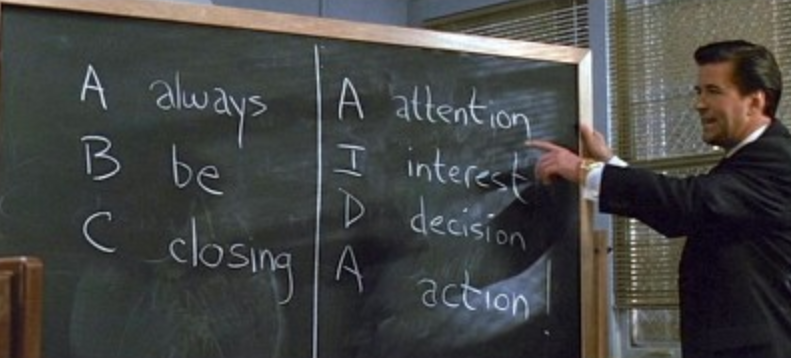
Alec Baldwin, in the 1992 movie, "Glengarry Glen Ross", made the line "Always Be Closing" famous. The classic formula for sales people has always been--make your presentation, then ask for the order. I have a business associate friend who I nicknamed "The Closer" because he's always closing, no matter what's being discussed. By the time "The Closer" is done selling, the customer is wondering why he even considered anyone else or any other product.
When you ask a real estate agent what the most important thing to consider when buying a property, the answer is always LOCATION, LOCATION, LOCATION. And when you ask a true salesperson what they most important quality of a top performer is SELL, SELL, SELL.
There is no top performer of any sport or profession who is not always on, always thinking about how to perform better, how to achieve absolute perfection.
Selling is a profession as honorable as any and no one engaged in this profession should ever sell themselves short. As an honorable profession, those who are salespeople should do everything possible to perform at the top of their capabilities.
Stand tall as a salesperson; be proud of your profession; never apologize--but ALWAYS BE CLOSING.
When you ask a real estate agent what the most important thing to consider when buying a property, the answer is always LOCATION, LOCATION, LOCATION. And when you ask a true salesperson what they most important quality of a top performer is SELL, SELL, SELL.
There is no top performer of any sport or profession who is not always on, always thinking about how to perform better, how to achieve absolute perfection.
Selling is a profession as honorable as any and no one engaged in this profession should ever sell themselves short. As an honorable profession, those who are salespeople should do everything possible to perform at the top of their capabilities.
Stand tall as a salesperson; be proud of your profession; never apologize--but ALWAYS BE CLOSING.
Wednesday, May 23, 2018
Selling is Teaching and Never Forget That
Think about what you liked about your favorite teacher from grade school, high school or college. I can pretty well guess what you liked: The good teacher cares and shows that fact by connecting with you--especially with the eyes. I went to a doctor recently and noted that, during the time he was with me, he only looked at me three times. The rest of the time his eyes were locked onto his computer screen. A good teacher connects with the students with eye contact. A good salesman does the same.
Another thing that identifies a good teacher is knowledge of the subject. A student can tell immediately whether a teacher knows what he's talking about. Product knowledge is critical to good sales.
Good teachers ask questions to make sure the students understand what they're taught. A couple of thousand years ago, a Greek philosopher name Socrates, developed a method of teaching we now call the Socratic method. It involves using questions and answers to arrive at an understanding. Good teachers use this method to help students understand a subject. Good salespeople should use the same approach. Don't come into the sales situation with an answer--come in with questions and let the customer arrive at the solution.
Remember how, as you were growing up, you said to yourself that when you're a parent, you won't do this or that that your parents did and you didn't like.
Think that way as a salesperson. What do you like about that car salesperson you deal with; what don't you like. Learn from watching and observing.
Stop being a salesperson, and become a good teacher; stop selling and start observing; stop talking and listen.
Subscribe to:
Posts (Atom)